Pirate name generator
Generate pirate-inspired names for stories, games, parties, and tabletop characters.
Fun facts about pirates!
Pirates, those fascinating characters that have inspired countless stories, movies, and games, are often misunderstood. Here’s some trivia that might make you exclaim, "shiver me timbers!"
Contrary to popular belief, pirates did not all use one standard skull-and-crossbones flag. Historical pirates and privateers used intimidation, reputation, and changing signals as practical tools at sea, while later books, art, and films helped turn a few images into the familiar Jolly Roger tradition.
It’s also a misconception that all pirates were men. There were female pirates who either disguised themselves as men or fought alongside them. Anne Bonny and Mary Read, who sailed with Calico Jack Rackham in the Caribbean, were among the most notorious female pirates. They were captured in 1720 and sentenced to death, but both pleaded pregnancy, delaying execution. Mary Read died in prison, while Anne Bonny's final fate remains uncertain.
Pirates also had a code of conduct, which differed from crew to crew. Common rules included sharing the loot equally, obeying the captain and the quartermaster, keeping the ship clean and tidy, and refraining from fighting or gambling on board. Some codes even had rules about drinking, smoking, swearing, and treating prisoners. Pirates who broke these rules could face severe punishments such as flogging, marooning, or keelhauling.
Interestingly, not all pirates were outlaws. Some were hired by governments or private companies to attack enemy ships or protect trade routes. These pirates, known as privateers, had a letter of marque that authorized their actions. Sir Francis Drake, who raided Spanish ships for Queen Elizabeth I of England, and Henry Morgan, who sacked Panama City for King Charles II of England, were among the most famous privateers.
Lastly, the theatrical pirate voice most people recognize today is heavily shaped by fiction, stage performance, and screen portrayals. Words such as "avast", "ahoy", "matey", "booty", and "buccaneer" have nautical or historical associations, but modern pirate-speak is more entertainment shorthand than a precise record of how every pirate crew talked.
Blackbeard the pirate
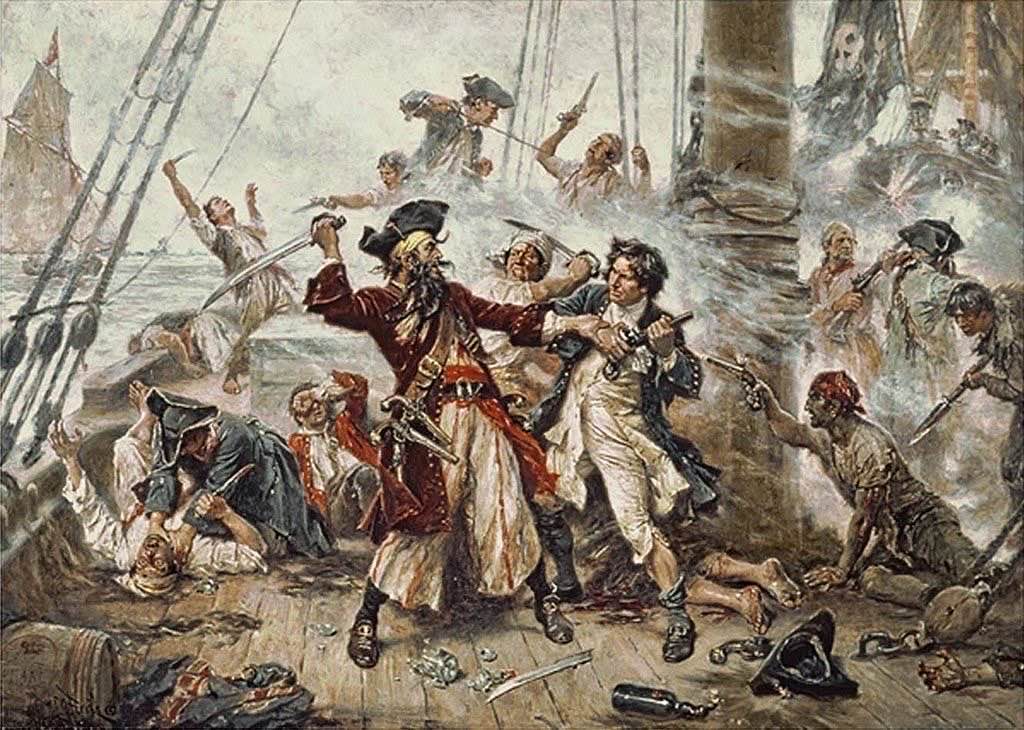
Blackbeard: The Pirate Who Ruled the Seas
When one thinks of a notorious pirate, the name Blackbeard often comes to mind. But who was this infamous marauder and why does his legend persist? In this article, we delve into the life and lore of Edward Teach, better known as Blackbeard, a notorious pirate who terrorized the Caribbean and Atlantic in the early 18th century.
The Mysterious Beginnings of Edward Teach
Blackbeard's early life remains shrouded in mystery. It is believed that he was born around 1680 in Bristol, England, and may have served as a sailor on privateer ships during Queen Anne's War (1702-1713). Privateers were essentially sanctioned pirates, authorized by their governments to attack enemy vessels and retain a portion of the spoils. With the end of the war, many privateers turned to piracy, capitalizing on the abundance of wealthy merchant ships traversing the Atlantic.
Blackbeard began his piratical career under the tutelage of Captain Benjamin Hornigold, a renowned pirate based in the Bahamas. Hornigold granted Blackbeard command of a captured sloop, and together they committed numerous acts of piracy. Their primary targets were Spanish and French ships, but they did not hesitate to attack British vessels when supplies ran low.
Blackbeard's Ascendancy
In 1717, Blackbeard seized a French slave ship named La Concorde, which he rechristened Queen Anne's Revenge and armed with 40 guns. He also amassed a crew of over 300 men, establishing himself as one of the most formidable pirates in the Caribbean. His moniker "Blackbeard" was derived from his thick, black beard, which he would braid and adorn with ribbons. To further enhance his terrifying image, he wore a bandolier with six pistols across his chest and lit fuses under his hat.
Blackbeard was a strategic and cunning leader who relied heavily on fearsome reputation and intimidation. Accounts describe him wearing pistols and slow-burning matches to create a terrifying image during encounters, and his association with pirates such as Benjamin Hornigold and Stede Bonnet helped build his short but notorious career.
One of Blackbeard's most audacious acts was the blockade of Charleston, South Carolina, in May 1718. He halted all incoming and outgoing ships for several days, demanding a chest of medicine as ransom for the town's residents. He also took several hostages, including members of the governor's council, and threatened to execute them if his demands were not met. The governor eventually acquiesced to the ransom, and Blackbeard released the hostages unscathed.
Blackbeard's Demise
Following the Charleston blockade, Blackbeard ran his flagship, Queen Anne's Revenge, aground on a sandbar near Beaufort, North Carolina. He then deserted most of his crew, absconding with a select group of loyal men and a significant amount of treasure. He settled in Bath Town, North Carolina, where he received a royal pardon from Governor Charles Eden as part of a pirate amnesty.
However, Blackbeard soon resumed his piratical activities, raiding ships along the coasts of Virginia and North Carolina. This drew the attention of Governor Alexander Spotswood of Virginia, who perceived Blackbeard as a threat to commerce and security. Spotswood dispatched two sloops with 60 men, led by Lieutenant Robert Maynard, to apprehend or kill Blackbeard.
On November 22, 1718, Maynard located Blackbeard anchored at Ocracoke Island, North Carolina. A brutal battle ensued, with both sides exchanging heavy fire. Blackbeard boarded Maynard's sloop and engaged him in close combat. Legend has it that Blackbeard fought valiantly, sustaining at least five gunshot wounds and 20 sword cuts before he was finally slain. As a grisly trophy, Maynard severed Blackbeard's head and displayed it on his ship's bow.
Blackbeard's Enduring Legacy
Blackbeard's death signaled the end of a golden age of piracy in the Atlantic. His daring exploits have inspired countless stories, myths, and legends that continue to captivate audiences today.
Anne Bonny the pirate
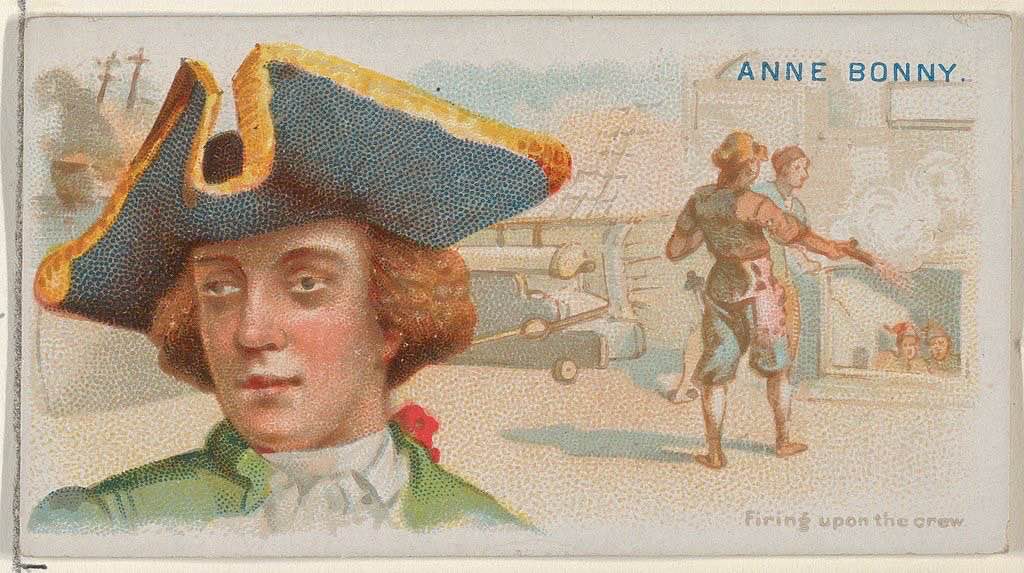
Anne Bonny: A Notorious Irish-Born Pirate
Anne Bonny, a name that echoed with notoriety and intrigue in the 18th century, was an Irish-born pirate known for her audacious spirit. Born around 1700 as the illegitimate child of a lawyer and his housemaid, she hailed from Ireland before moving to the American colonies with her parents. There, she married a sailor named James Bonny, but the monotony of domestic life soon lost its appeal.
Drawn to the thrilling life of piracy, she abandoned her husband to join the crew of the charismatic pirate captain, Jack Rackham, also known as Calico Jack. Disguising herself as a man, she fought alongside him in the Caribbean, not just as a crew member, but also as his lover.
On Calico Jack’s ship, Anne Bonny wasn’t the only woman defying societal norms. She formed a close friendship with Mary Read, another woman who had disguised herself as a man to join the navy before turning to piracy. Both women were admired for their courage, skill, and defiance, and they shared a disdain for their male counterparts who would cower or succumb to drunkenness during attacks.
Their bravery was put to the test in October 1720 when a British naval vessel, led by Captain Jonathan Barnet, attacked Calico Jack’s ship near Jamaica. While most of the pirates surrendered without resistance, Anne Bonny and Mary Read fought valiantly until they were eventually captured. Along with Calico Jack and the rest of the crew, they were taken to Spanish Town, Jamaica, for trial.
Found guilty of piracy, both women were sentenced to death by hanging. However, they managed to delay their execution by claiming to be pregnant. Calico Jack, on the other hand, met his end on November 18th, 1720. It is said that Anne Bonny’s parting words to him were a scathing rebuke: "Had you fought like a man, you need not have been hanged like a dog."
While Mary Read died in prison in April 1721, the fate of Anne Bonny remains shrouded in mystery. Surviving records do not clearly confirm whether she was released, died in custody, or lived under another name. Regardless of her ultimate fate, Anne Bonny’s legacy as a woman who defied the expectations of her era endures in pirate history and popular culture.

References
 The Golden Age of Piracy | Royal Museums Greenwich
- Blackbeard: History of the Dreaded Pirate | Queen Anne's Revenge Project
- Blackbeard Biography & Facts | Britannica
- Blackbeard Biography & Facts | World History Encyclopedia
- Anne Bonny Biography & Facts | Britannica
- Anne Bonny, Firing Upon the Crew | The Metropolitan Museum of Art
- Capture of Blackbeard image record | Wikimedia Commons